Air Care Colorado: News Flash

Maintenance

Does Matter! 

tire_on_road.jpg 
Remember, regular vehicle maintenance extends the life of your car, helps clean the air and saves you $$$!


Air Care Colorado: Facts at a Glance

facts-2.jpgMake sure you need a test before you present your vehicle for testing! State regulation (D.O.R. Air Program Regulation 2,200-E) requires testing centers to test all vehicles that are presented for testing.

Air Care Colorado
Advisory
Current Air Quality Conditions

Air Care Colorado Emission Test

Welcome to AirCare Colorado

Vehicle emissions testing is part of the State of Colorado's overall strategy to improve air quality in and around Denver, Boulder and the North Front Range. Vehicles are one of the largest contributors to harmful air pollution that leads to adverse health effects. The testing program is designed to reduce those pollutants including harmful ozone emissions. To find the answers to specific questions choose from the menus above, or visit our search our site.

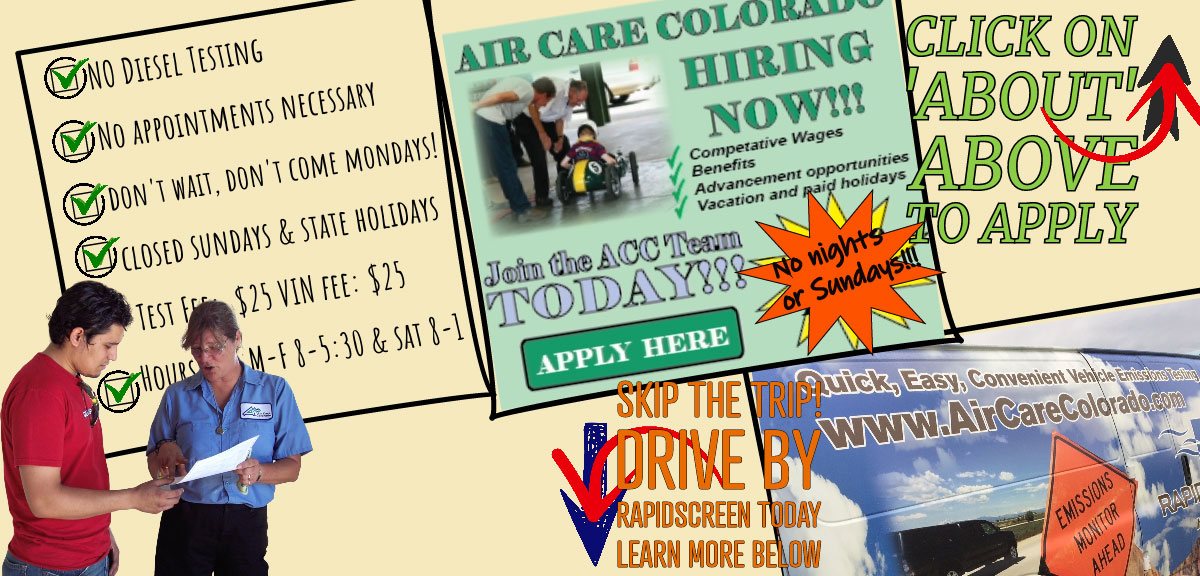
HOURS:       Mon. to Fri. 8 am to 5:30 pm & Sat. 8 am to 1 pm
PAYMENT:  Cash or check only.
(Please, NO temporary checks or checks with address different from ID.) 
NO CREDIT CARDS accepted. 


May
08

Environmentally Friendly Modes of Transportation to Utilize this Summer

Denver Skyline.pngSnow is melting away and as the weather becomes warmer, more opportunities to get around town emerge. If you are looking for more environmentally friendly modes of transportation to help you get to work, the grocery store, to school, wherever, we have ideas that are good for you, and the environment.

Use your feet

The simplest form of transportation, overlooked by many, is walking. Not only does a quick stroll aid in your health and well-being, you can cut air pollution caused by traffic. Walking yields in decreasing high blood pressure, high cholesterol, diabetes, heart disease risks and reduces stress. If you have a little extra time to spare, walking just makes sense!

Two-wheel it

Biking is a great mode of transportation. Not only does it allow you to get to destinations quickly, you also receive the added bonus of an aerobic workout. Biking promotes well-being for the heart and muscles, increases coordination, mental health and immunity. Denver makes it easy to bike from place to place, with plentiful trails throughout the city and the B-Cycle program.

Ride Along with Some Company

Denver offers great public transit options, from the RTD bus system to the light rail.  On average, Americans that choose to travel via public transportation save around 865 million hours in travel time and close to 450 million gallons of fuel each year. With the absence of current public transportation systems, congestion costs would have been an additional $21 billion.

Communities that choose to invest in public transit ultimately reduce the country’s carbon emissions by 37 million metric tons annually, which is equivalent to New York City, Washington, D.C., Atlanta, Denver and Los Angeles combined ceasing to use electricity. A single commuter switching their commute to bus or light rail can reduce a household’s carbon emissions by 10 percent.

The next time the sun is shining and the temperatures are on the rise, choose one of these environmentally friendly modes of transportation. They are good for you and Mother Earth!


Mar
05

Trip Linking

Enviromentalists call it “trip linking.”  You can call it “Savings.”

Most motorists don't realize that a single one-mile trip to the dry cleaners emits up to 70 percent as much pollution as a ten-mile excursion with several stops. If motorists cut their “cold starts” – starting a vehicle that has been sitting for an hour or more – many tons of pollutants could be removed from the air each day.  Just that simple change can make an enormous impact.  In fact, a study conducted in the San Francisco Bay area showed that if residents reduced their number of “cold starts” by 25 percent, they could remove up to 97 tons of pollutants from the air each day. What an achievement!

Even better, “trip linking” saves time, money and reduces air pollution – creating savings all around.

TripLinking Tips

Motor vehicles are one of the largest contributors to air pollution. An effective way for non-commuters to reduce automobile pollution is to "Trip-Link," or to combine several small car trips into one larger trip.

Non-commuters include parents taking their kids to school, seniors, shoppers, weekend travelers, church goers . . .in effect, everyone who drives. Commuters, too, add to the non-commuter problem when they leave their office by car during the day to run errands or go out to lunch.

If you must drive, you can reduce your vehicle’s emissions by minimizing "cold starts" and short/single-errand trips. A cold car, one that’s been sitting for an hour or more, pollutes up to five times more than a warm car. This is because the engine's air pollution control device, the catalytic converter, takes several minutes to warm up and work efficiently. By linking trips together and keeping your car engine warm, you can avoid cold starts.

Trip Linking is easy, and it will save you time and money.  Here are some tips to get you started:

  • Keep a running list of errands you need to do.
  • Give yourself enough time and plan ahead.
  • Think before you drive:
"Do I really need to make this trip?"
"How can I combine this errand with another trip I'll be making this week?"
  • Try to match items on your list that are located near each other. 

For example, if your child's school is located near your dry cleaner and post office, three trips could be linked together into one!


Feb
13

Don't Miss the Bus

The Denver area’s Regional Transportation District (RTD) bus service provides alternative transportation for those who do not have or do not wish to use a car. From everyday commutes to specialty rides, RTD has a variety of metro area schedules and routes Bus1.pngto take you where you need to go fast and hassle-free; 365 days a year. All buses are wheelchair accessible and have bike racks for your convenience.

You know that RTD can carry more people at one time than a single car or truck, reducing the number of automobiles discharging emissions into the air, but did you know RTD is taking notable measures to be the most sustainable mode of transportation in the country?

Not only does RTD use alternative fuels such as electric propulsion and low sulfur diesel fuel in conjunction with hybrid-electric engine technology, but they have been named the leaders in promoting renewable energy and energy efficiency from the Department of Energy’s National Renewable Energy Laboratories.

RTD’s engine technology is constantly evolving. The biodiesel bus engines lower exhaust emissions and reduce dependence on foreign oil. The fleet of 16th Street mall buses operate on Compressed Natural Gas (CNG) and electric motors to further combat our carbon footprint. These buses can carry 116 people running on an engine that is comparable to the engine size of the Toyota Prius Hybrid; and they are free to use.

This public transportation is so efficient it produces 95 percent less carbon monoxide and 50 percent less carbon dioxide per passenger mile than private vehicles.

Think of the gas money RTD can help you save. Withdaily and monthly passes and ticket books, you can buy rides in bulk and do your part to keep the air clean.

There is one more great thing about Denver’s RTD – they actually “walk-the-walk” by being a truly an environmentally conscientious organization.  RTD’s vehicles aren’t the only part of their system that is conscious of the environment. The RTD facilities use energy reducing heating and lighting, and are creatively designed to be environmentally friendly. They also have recycle programs for oil, engine fluids, and tires along with their office supplies and equipment.

From the factory to the streets, RTD is functioning with the environment in mind.

So next time you jump in your car, think of all the ways RTD is providing to make it easier and more cost efficient to just simply catch the bus.